Kód: 38739928
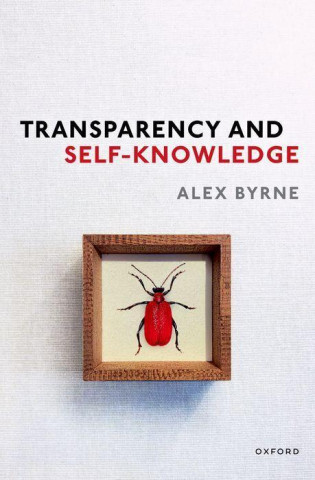
Transparency and Self-Knowledge
Autor Byrne, Alex (Professor of Philosophy, Professor of Philosophy, Massachusetts Institute of Technology)
Alex Byrne sets out and defends a theory of self-knowledge-knowledge of one's mental states. Inspired by Gareth Evans' discussion of self-knowledge in his The Varieties of Reference, the basic idea is that one comes to know that o ... celý popis


- Jazyk:
 Angličtina
 - Väzba: Brožovaná
- Počet strán: 240
Nakladateľ: Oxford University Press, 2022
- Viac informácií o knihe


Mohlo by sa vám tiež páčiť
-

Moonwalk
14.17 € -

The Score
13.97 € -19 % -

The Deal
12.65 € -23 % -

The Mistake
14.57 € -12 % -

Jujutsu Kaisen, Vol. 30
11.23 € -14 % -

Witch Hat Atelier: Grimoire Edition 1
34.63 € -29 % -
Invincible Compendium Volume 2
48.30 € -22 % -

Berserk Deluxe Volume 1
35.54 € -26 % -
Invincible Compendium Volume 1
45.87 € -24 % -

The Goal
14.68 € -11 % -

Berserk Deluxe Volume 2
33.31 € -30 % -

Witch Hat Atelier Manga Box Set 1
56.20 € -25 % -

Heated Rivalry
12.65 € -7 % -

Jujutsu Kaisen, Vol. 25
9.92 € -20 % -

Lord of Mysteries, Vol. 3: The Clown, Part III
14.98 € -29 % -

Jujutsu Kaisen, Vol. 26
9.92 € -20 % -

Moonwalk: A Memoir
21.77 € -24 % -

Jujutsu Kaisen, Vol. 29
9.92 € -20 % -

Invincible Compendium Volume 3
45.87 € -24 % -

Murdoku
17.11 € -29 % -

Berserk Deluxe Volume 3
55.19 €
Darujte túto knihu ešte dnes
- Objednajte knihu a vyberte Zaslať ako darček.
- Obratom obdržíte darovací poukaz na knihu, ktorý môžete ihneď odovzdať obdarovanému.
- Knihu zašleme na adresu obdarovaného, o nič sa nestaráte.
Viac informácií o knihe Transparency and Self-Knowledge
Nákupom získate 79 bodov
 Anotácia knihy
Alex Byrne sets out and defends a theory of self-knowledge-knowledge of one's mental states. Inspired by Gareth Evans' discussion of self-knowledge in his The Varieties of Reference, the basic idea is that one comes to know that one is in a mental state M by an inference from a worldly or environmental premise to the conclusion that one is in M. (Typically the worldly premise will not be about anything mental.) The mind, on this account, is 'transparent': self-knowledge is achieved by an 'outward glance' at the corresponding tract of the world, not by an 'inward glance' at one's own mind. Belief is the clearest case, with the inference being from 'p' to 'I believe that p'. One serious problem with this idea is that the inference seems terrible, because 'p' is at best very weak evidence that one believes that p. Another is that the idea seems not to generalize. For example, what is the worldly premise corresponding to 'I intend to do this', or 'I feel a pain'? Byrne argues that both problems can be solved, and explains how the account covers perception, sensation, desire, intention, emotion, memory, imagination, and thought. The result is a unified theory of self-knowledge that explains the epistemic security of beliefs about one's mental states (privileged access), as well as the fact that one has a special first-person way of knowing about one's mental states (peculiar access).
Parametre knihy
32.70 €
- Celý názov: Transparency and Self-Knowledge
- Autor: Byrne, Alex (Professor of Philosophy, Professor of Philosophy, Massachusetts Institute of Technology)
- Jazyk: Angličtina
- Väzba: Brožovaná
- Počet strán: 240
- EAN: 9780192868992
- ISBN: 0192868993
- ID: 38739928
- Nakladateľ: Oxford University Press
- Hmotnosť: 390 g
- Rozmery: 234 × 156 × 13 mm
- Dátum vydania: 23. June 2022
Osobný odber Bratislava a 12762 dalších
Copyright ©2008-26 najlacnejsie-knihy.sk Všetky práva vyhradenéSúkromieCookies

 24 miliónov titulov
 Vrátenie do mesiaca
 02/210 210 99 (8-15.30h)