Kód: 05083192
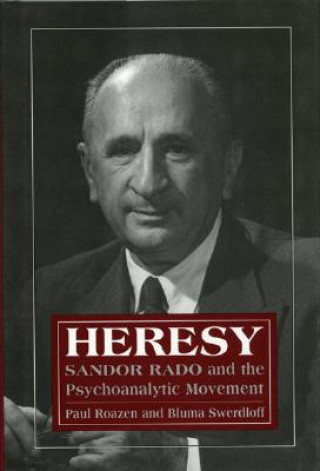
Heresy
Autor Paul Roazen, Bluma Swerdloff
'My mother was the source of my brains and my father the mother of kindness,' said Sandor Rado, a Hungarian analyst whom Freud first embraced but with whom he was later displeased. In Heresy: Sandor Rado and the Psychoanalytic Mov ... celý popis


- Jazyk:
 Angličtina
 - Väzba: Pevná
- Počet strán: 232
Nakladateľ: Jason Aronson Inc. Publishers, 1977
- Viac informácií o knihe

108.95 €
Bežne: 114.32 €
Ušetríte 5.37 €
Dostupnosť:
50 % šanca Máme informáciu, že by titul mohol byť dostupný. Na základe vašej objednávky sa ho pokúsime do 6 týždňov zabezpečiť.
Prehľadáme celý svet
Mohlo by sa vám tiež páčiť
-

Dinosaurs--The Grand Tour, Second Edition: Everything Worth Knowing about Dinosaurs from Aardonyx to Zuniceratops
18.22 € -25 % -

Period Power
14.17 € -29 % -

Way of the Peaceful Warrior
16.70 € -6 % -

Fortunata Y Jacinta
15.79 € -

Areopagitica and Other Writings
13.15 € -26 % -

Che
25.41 € -26 % -

You Are We
12.75 € -

Silent night
4.55 € -14 % -

Magia rytualna
9.31 € -15 % -

It Follows
31.38 € -
Jean-Luc Nancy and Plural Thinking
39.38 € -

Advances in Chemical Physics V91
494.05 € -10 % -

Paul Martin & Companies
12.95 € -9 % -

Boundary Value Problems From Higher Order Differential Equations
79.08 €
Darujte túto knihu ešte dnes
- Objednajte knihu a vyberte Zaslať ako darček.
- Obratom obdržíte darovací poukaz na knihu, ktorý môžete ihneď odovzdať obdarovanému.
- Knihu zašleme na adresu obdarovaného, o nič sa nestaráte.
Informovať o naskladnení knihy
Zadajte do formulára e-mailovú adresu a akonáhle knihu naskladníme, zašleme vám o tom správu. Postrážime všetko za vás.
Viac informácií o knihe Heresy
Nákupom získate 263 bodov
 Anotácia knihy
'My mother was the source of my brains and my father the mother of kindness,' said Sandor Rado, a Hungarian analyst whom Freud first embraced but with whom he was later displeased. In Heresy: Sandor Rado and the Psychoanalytic Movement, Paul Roazen and Bluma Swerdloff use interviews with Rado and his family to bring to life one of Freud's foremost followers, who later founded his own institute and psychodynamic orientation, one that focused on motivation rather than instinct. Based on interviews sponsored by the Columbia University Oral History Project, and including Freud's letters to Rado, this is a personal account of Rado and the life events that shaped him and his theories. Rado's life in late nineteenth-century Hungary, the enduring influence of his mother, his meetings with Freud (who made three slips of the tongue during their first encounter), his analysis with Karl Abraham, his affair with Helene Deutsch (she called it a 'companionship of suffering'), and Rank and Ferenczi's downfalls are vividly depicted. Rado's radical departure from Freudian theories of femininity, a reformulation daringly in keeping with today's gender debates, is also included. Rado freed himself from phallocentrism, abandoning the notions of universal castration fear and penis envy. He contended that men and woman are different, which does not mean that women are inferior. He saw women as having a greater emotional capacity based on their biological role as child bearers and nurturers. In 1963, as further evidence of his prescience, Rado prophesied the current crisis in psychotherapy, noting that 'the old-fashioned therapeutic practice will disappear for lack of money.' He anticipated that the influence of biochemical genetics was going to be 'so enormous that it would be bootless to try to outline it.' Dr. Swerdloff uses Rado's predictions and an analysis of the present debate to demonstrate the need to steer psychoanalysis toward a more scientific course.
Parametre knihy
Zaradenie knihy Knihy po anglicky Society & social sciences Society & culture: general Cultural studies
108.95 €
- Celý názov: Heresy
- Podnázov: Sandor Rado and the Psychoanalytic Movement
- Autor: Paul Roazen, Bluma Swerdloff
- Jazyk: Angličtina
- Väzba: Pevná
- Počet strán: 232
- EAN: 9781568213217
- ISBN: 1568213212
- ID: 05083192
- Nakladateľ: Jason Aronson Inc. Publishers
- Hmotnosť: 454 g
- Rozmery: 217 × 148 × 20 mm
- Dátum vydania: 07. July 1977
Obľúbené z iného súdka
-

All About Love
13.05 € -12 % -
The Chalice and the Blade
14.07 € -25 % -

Tihkal
23.79 € -25 % -

Medieval Costume and How to Recreate it
11.03 € -26 % -

Utopia for Realists
13.56 € -22 % -

How to Invent Everything
27.03 € -18 % -

Postmodernism
27.53 € -

Origin of the Family, Private Property and the State
15.18 € -15 % -

The Year of Living Danishly
13.76 € -13 % -

Polish Cinema
32.70 € -

Kinesthetic Empathy in Creative and Cultural Practices
51.84 € -

Dress Your Best
15.18 € -26 % -

Sekiro: The Second Life Of Souls
21.66 € -25 % -

How to Talk about Videogames
23.58 € -

Sapiens
12.34 € -25 % -

Pihkal
25.10 € -25 % -

Wabi-Sabi for Artists, Designers, Poets & Philosophers
14.77 € -25 % -

Self-Made Man
10.42 € -30 % -
Cosmos and Psyche
16.19 € -25 % -

The Conquest of Bread
11.84 € -25 % -

Ghosts of My Life
15.69 € -30 % -

Berserk: With Darkness Ink
21.66 € -25 % -

Notes on Camp
4.24 € -13 % -

Japanese Tattoos
13.36 € -25 % -
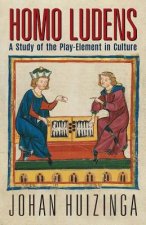
Homo Ludens
14.07 € -

Origins and History of Consciousness
25 € -4 % -
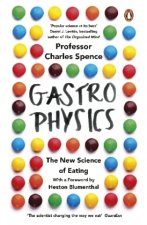
Gastrophysics
13.86 € -20 % -
Ways of Curating
11.13 € -29 % -

The Tipping Point
12.75 € -27 % -
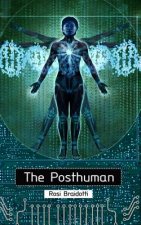
Posthuman
19.43 € -1 % -

Egregores
12.75 € -25 % -

Sapiens
14.67 € -27 % -

Greatest Minds and Ideas of All Time
16.09 € -24 % -

Energy Flash
21.25 € -25 % -

Revolution in the Head
14.07 € -25 % -

Replay: the History of Video Games
24.39 € -6 % -

Argentina Reader
22.37 € -25 % -
Culture Industry
27.63 € -

Fourier: 'The Theory of the Four Movements'
18.32 € -24 % -

Resistance
31.99 € -7 % -

Telling Lies
13.05 € -26 % -

Art of Memory
20.24 € -24 % -

Vader's Little Princess
13.76 € -18 % -

Cultures and Organizations: Software of the Mind, Third Edition
35.13 € -10 % -

Communion
11.84 € -25 % -
Understanding Media
25.61 € -5 % -

TechGnosis
16.19 € -24 % -

Why We Love Dogs, Eat Pigs and Wear Cows
14.27 € -27 % -

Tudor Tailor
26.52 € -24 %
Osobný odber Bratislava a 12593 dalších
Copyright ©2008-26 najlacnejsie-knihy.sk Všetky práva vyhradenéSúkromieCookies

 24 miliónov titulov
 Vrátenie do mesiaca
 02/210 210 99 (8-15.30h)