Kód: 04936921
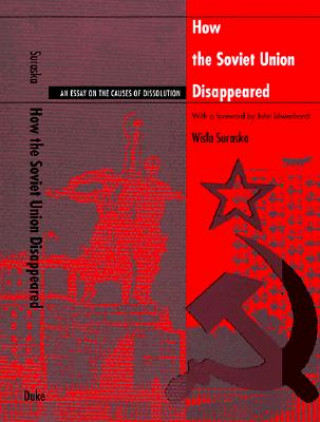
How the Soviet Union Disappeared
Autor Wisla Suraska
Many theories have been offered to explain the disintegration of the Soviet Union, yet none sufficiently explain the speed and profundity of the empire's collapse. In this powerful polemic, Wisla Suraska disputes popular interpret ... celý popis


- Jazyk:
 Angličtina
 - Väzba: Brožovaná
- Počet strán: 200
Nakladateľ: Duke University Press, 1998
- Viac informácií o knihe

24.29 €
Bežne: 26.98 €
Ušetríte 2.68 €
Dostupnosť:
50 % šanca Máme informáciu, že by titul mohol byť dostupný. Na základe vašej objednávky sa ho pokúsime do 6 týždňov zabezpečiť.
Prehľadáme celý svet
Mohlo by sa vám tiež páčiť
-

Reservations Book
19.33 € -2 % -

Dating
8.80 € -24 % -

Neuroanatomy Text and Atlas, Fifth Edition
97.71 € -

Introduction to Emptiness
21.25 € -25 % -

The Magician and the Cardsharp: The Search for America's Greatest Sleight-Of-Hand Artist
18.93 € -25 % -

Without the Smell of Fire
30.06 € -2 % -

Buy and Hold Is Dead - How to Make Money and Control Risk in Any Market
25.10 € -25 % -

Claves para una alimentación óptima : qué nos aportan los alimentos y cómo utilizarlos a lo largo de la vida
35.03 € -

Átkelés a Szuezi-csatornán
14.57 € -14 % -

Jerarquía estructural de las proteínas
20.55 € -

VIDA y la prosperidad humana sin vida
13.46 € -7 % -

PayDay Principles Does What I Do Really Matter
15.58 € -

From Felt to Fabulous
9.71 € -9 % -

Factor de Crecimiento del Endotelio Vascular tras Terapia Fotodinamica
52.65 € -14 %
Darujte túto knihu ešte dnes
- Objednajte knihu a vyberte Zaslať ako darček.
- Obratom obdržíte darovací poukaz na knihu, ktorý môžete ihneď odovzdať obdarovanému.
- Knihu zašleme na adresu obdarovaného, o nič sa nestaráte.
Informovať o naskladnení knihy
Zadajte do formulára e-mailovú adresu a akonáhle knihu naskladníme, zašleme vám o tom správu. Postrážime všetko za vás.
Viac informácií o knihe How the Soviet Union Disappeared
Nákupom získate 59 bodov
 Anotácia knihy
Many theories have been offered to explain the disintegration of the Soviet Union, yet none sufficiently explain the speed and profundity of the empire's collapse. In this powerful polemic, Wisla Suraska disputes popular interpretations of the dissolution of the Soviet Union, and explains how theories, such as totalitarian theory, have failed to examine the exigencies of arbitrary government. At the centre of Suraska's own theories on the Soviet collapse is her claim that it came about not simply because it was an economically declining country that contained too many nationalities, but because it was despotic and that despotism is unworkable in modern societies. Using numerous secondary sources, recently published memoir literature, and new archival research, Suraska's multidimensional study delves into the many factors involved in the dissolution of the Soviet empire - the role of Gorbachev and his contest with Yeltsin, the weakness of the Soviet state, and the poverty of ideas that informed perestroika. She also examines the complex relationship between the Communist Party, the KGB, and the military; the way Gorbachev dealt with the German question; and the rise of post-Marxist thought in the Soviet Union. Whether discussing how insufficient control over coercive forces or the growing strength of provincial barons impacted the collapse, Suraska furthers her argument that the explosion of nationalisms in the Soviet Union was as much activated by the breakdown of central structures as it actually contributed to the final demolition of the regime. In the end, "How the Soviet Union Disappeared" reveals Gorbachev's perestroika as having been nothing short of a radical attempt to rebuild power that the Soviet centre had lost in the post-Stalinist period. In its questioning of the assumptions of most previous scholarship and discourse on the Soviet Union, this book will be of interest to Sovietologists, political scientists, and students of communism and nationalism.
Parametre knihy
Zaradenie knihy Knihy po anglicky Humanities History History: earliest times to present day
24.29 €
- Celý názov: How the Soviet Union Disappeared
- Podnázov: An Essay on the Causes of Dissolution
- Autor: Wisla Suraska
- Jazyk: Angličtina
- Väzba: Brožovaná
- Počet strán: 200
- EAN: 9780822321248
- ISBN: 0822321246
- ID: 04936921
- Nakladateľ: Duke University Press
- Hmotnosť: 320 g
- Rozmery: 224 × 146 × 18 mm
- Dátum vydania: 11. December 1998
Obľúbené z iného súdka
-

Tuesdays With Morrie
9.71 € -34 % -

Guns, Germs, and Steel
10.93 € -10 % -

Medieval Costume and How to Make It
11.23 € -2 % -

Illustrated Encyclopedia of Uniforms of World War I
21.25 € -25 % -

Egyptian Book of the Dead: The Book of Going Forth by Day : The Complete Papyrus of Ani Featuring Integrated Text and Full-Color Images (History ... M
32.70 € -8 % -

Swerve
12.34 € -5 % -

Streams of Gold, Rivers of Blood
30.27 € -12 % -

Illuminated Manuscripts
9.71 € -25 % -

Landmark Arrian
25.10 € -25 % -

Dividing the Spoils
14.67 € -9 % -

Annals
13.96 € -24 % -

Alexander the Great
10.62 € -25 % -

History of the Medieval World
28.65 € -24 % -

History of Ancient Egypt
16.09 € -24 % -
Lords of the Sea
25.20 € -18 % -

Poison King
14.77 € -25 % -

1453
14.77 € -25 % -

4th Fighter Wing in Korean War
32.19 € -26 % -
Ancient Greece: A Very Short Introduction
9.91 € -25 % -

Book of Marvels and Travels
10.82 € -25 % -
Cities that Shaped the Ancient World
13.15 € -29 % -
Athens
15.79 € -20 % -

Rwanda Crisis
25.10 € -4 % -

Oxford Handbook of Postwar European History
57.20 € -

FN FAL Battle Rifle
17.20 € -26 % -

Roman Auxiliary Forts 27 BC-AD 378
18.12 € -15 % -

Templars
18.12 € -25 % -

Failure of Empire
39.58 € -

Rise of Rome
22.88 € -9 % -

Fascists
27.94 € -24 % -

Forgotten Kingdom
37.15 € -7 % -

Those Who Were There
25.81 € -25 % -

Lords Of Avaris
18.12 € -25 % -

The Origins of Totalitarianism
13.15 € -34 % -

From Third World to First
19.84 € -

Learn to Read Ancient Sumerian
28.34 € -2 % -

Book of Margery Kempe
11.03 € -27 % -

Secret Team
18.32 € -24 % -

On Tyranny
10.01 € -27 % -
Gallic War
7.89 € -24 % -

Oxford Illustrated History of Prehistoric Europe
38.98 € -10 % -

Fall of Carthage
16.09 € -24 % -
24 Hours in Ancient Athens
9.10 € -30 % -
Oxford Handbook of Neolithic Europe
61.86 € -

History of the Decline and Fall of the Roman Empire
14.88 € -24 % -

Peloponnesian War
13.96 € -24 % -

Alexander the Great
14.17 € -23 % -

Distant Mirror
14.98 € -29 % -
Complete Roman Army
21.25 € -25 %
Osobný odber Bratislava a 12542 dalších
Copyright ©2008-26 najlacnejsie-knihy.sk Všetky práva vyhradenéSúkromieCookies

 24 miliónov titulov
 Vrátenie do mesiaca
 02/210 210 99 (8-15.30h)