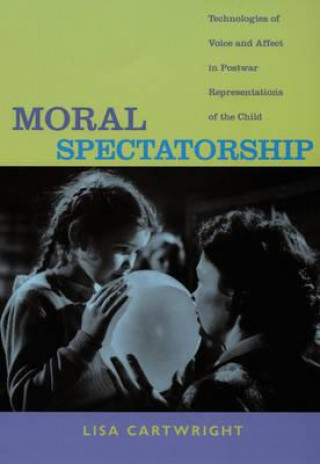
Kód: 04938700
Moral Spectatorship
Autor Lisa Cartwright
In Moral Spectatorship, Lisa Cartwright rethinks the politics of spectatorship in film studies. At the same time, she offers a new theory of the human subject that takes into account affective relationships and technologies that f ... celý popis


- Jazyk:
 Angličtina
 - Väzba: Pevná
- Počet strán: 304
Nakladateľ: Duke University Press, 2008
- Viac informácií o knihe

155.93 €
Dostupnosť:
50 % šanca Máme informáciu, že by titul mohol byť dostupný. Na základe vašej objednávky sa ho pokúsime do 6 týždňov zabezpečiť.
Prehľadáme celý svet
Mohlo by sa vám tiež páčiť
-

Fruits of Bali
0 € -100 %
Darujte túto knihu ešte dnes
- Objednajte knihu a vyberte Zaslať ako darček.
- Obratom obdržíte darovací poukaz na knihu, ktorý môžete ihneď odovzdať obdarovanému.
- Knihu zašleme na adresu obdarovaného, o nič sa nestaráte.
Informovať o naskladnení knihy
Zadajte do formulára e-mailovú adresu a akonáhle knihu naskladníme, zašleme vám o tom správu. Postrážime všetko za vás.
Viac informácií o knihe Moral Spectatorship
Nákupom získate 377 bodov
 Anotácia knihy
In Moral Spectatorship, Lisa Cartwright rethinks the politics of spectatorship in film studies. At the same time, she offers a new theory of the human subject that takes into account affective relationships and technologies that facilitate human agency. Seeking to expand concepts of representation beyond the visual, Cartwright develops her theory through interpretations of two contexts in which adult caregivers help bring children to voice. She considers mid-twentieth-century social-problem melodramas about deaf and nonverbal girls and young women, including Johnny Belinda, Thursday's Children, The Miracle Worker, and Children of a Lesser God. Cartwright also analyzes the controversies surrounding facilitated communication, a technological practice in which caregivers help children with communication disorders achieve "voice" through writing facilitated by computers. This practice has inspired contempt among many professional and lay people who charge that the facilitator can manipulate the child's speech. For more than two decades, film theory has been dominated by a model of identification tacitly based on the idea of feeling what the other feels or of imagining oneself to be the other. Cartwright argues that the custodial relationships underlying both the melodramas and facilitated speech involve a different kind of identification, which she calls "empathetic." In empathetic identification, the subject does not necessarily feel the other's feelings or imagine him or herself in the other's place; rather he or she recognizes and enables the otherness of the other. Building on the theories of affect developed by the French psychoanalyst Andre Green and the American cognitive psychologist Silvan Tomkins, Cartwright develops a theory of spectatorship based on empathetic identification.
Parametre knihy
Zaradenie knihy Knihy po anglicky The arts Film, TV & radio Films, cinema
155.93 €
- Celý názov: Moral Spectatorship
- Podnázov: Technologies of Voice and Affect in Postwar Representations of the Child
- Autor: Lisa Cartwright
- Jazyk: Angličtina
- Väzba: Pevná
- Počet strán: 304
- EAN: 9780822341772
- ISBN: 0822341778
- ID: 04938700
- Nakladateľ: Duke University Press
- Hmotnosť: 666 g
- Dátum vydania: 18. March 2008
Obľúbené z iného súdka
-

Stranger Things: The Ultimate Pop-Up Book
77.56 € -7 % -

Lighting for Cinematography
34.93 € -19 % -

The Animator's Survival Kit
26.42 € -27 % -

Story
30.06 € -14 % -

Lynch on Lynch
14.77 € -28 % -

Filmmaker's Handbook, The (fifth Edition)
32.09 € -24 % -

Alien Covenant: David's Drawings
42.82 € -13 % -

Sculpting in Time
33.30 € -6 % -

Donnie Darko Book
14.07 € -25 % -

Starting Point: 1979-1996
14.77 € -25 % -

The Stanley Kubrick Archives
20.24 € -12 % -

Art of How to Train Your Dragon 2
30.98 € -29 % -
Movie Art of Syd Mead: Visual Futurist
36.34 € -21 % -

Star Wars - the Jedi Path
20.34 € -15 % -
Notes On The Cinematograph
12.04 € -24 % -

Jonesy
10.82 € -25 % -

Little Miss Sunshine
18.42 € -18 % -
Art of Ratatouille
31.68 € -25 % -

Fantastic Mr. Fox
28.04 € -27 % -

Painting With Light
37.15 € -12 % -

Jurassic World: The Ultimate Visual History
45.96 € -29 % -

War and Cinema
16.19 € -17 % -
Big Lebowski
12.04 € -25 % -

Disney Favorites
15.99 € -22 % -

The Celestine Prophecy
11.53 € -29 % -

Screenwriter's Workbook
14.88 € -24 % -

Cassavetes on Cassavetes
26.52 € -24 % -
Man with the Golden Eye: Designing the James Bond Films
33.91 € -19 % -

Sofia Coppola
17.41 € -11 % -

Mamma MIA! - noty
18.12 € -22 % -

Agatha Christie on Screen
34.22 € -

Montage
21.36 € -22 % -

Analysis of Film
27.63 € -

Star Trek: The Art of the Film
26.42 € -25 % -

Cinema of Sean Penn
115.53 € -

Essential Deren
16.60 € -7 % -

The Illusion of Life : Disney Animation
60.34 € -9 % -

Hollywood Babylon
8.29 € -29 % -

The Art of Princess Mononoke
25.10 € -26 % -

Spiderman Into the Spider-Verse
41.30 € -10 % -

Animator's Survival Kit
41.20 € -26 % -

Alien: The Blueprints
29.86 € -29 % -

On Directing Film
11.94 € -29 % -
Eat What You Watch
15.99 € -29 % -

Jurassic Park
45.96 € -29 % -

Jedi Vs. Sith
21.46 € -27 % -

Star Trek: Light-Up Starship Enterprise
11.64 € -20 % -

Alien: The Archive - The Ultimate Guide to the Classic Movies
39.79 € -26 % -

Into The Woods
13.96 € -24 %
Osobný odber Bratislava a 12542 dalších
Copyright ©2008-26 najlacnejsie-knihy.sk Všetky práva vyhradenéSúkromieCookies

 24 miliónov titulov
 Vrátenie do mesiaca
 02/210 210 99 (8-15.30h)